
LULC Data Explained: Land Use and Land Cover Mapping

Updated: Aug 26
Environmental Monitoring, Urban Planning, Agriculture, Natural Resource Management, and Climate Research all depend heavily on accurate and up-to-date data regarding Land Use and Land Cover (LULC); topographically mapped LULC data is an indispensable means of assessing one or more components of our world’s evolving landscape.
Thanks to the rapid advancement of geospatial technologies and satellite imagery, LULC mapping has emerged as one of the most significant means of evaluating our world’s changing environmental landscape.
Whether you are a GIS professional, environmental scientist, urban planner, or researcher, LULC data will allow you to make informed decisions based on accurate spatial data.
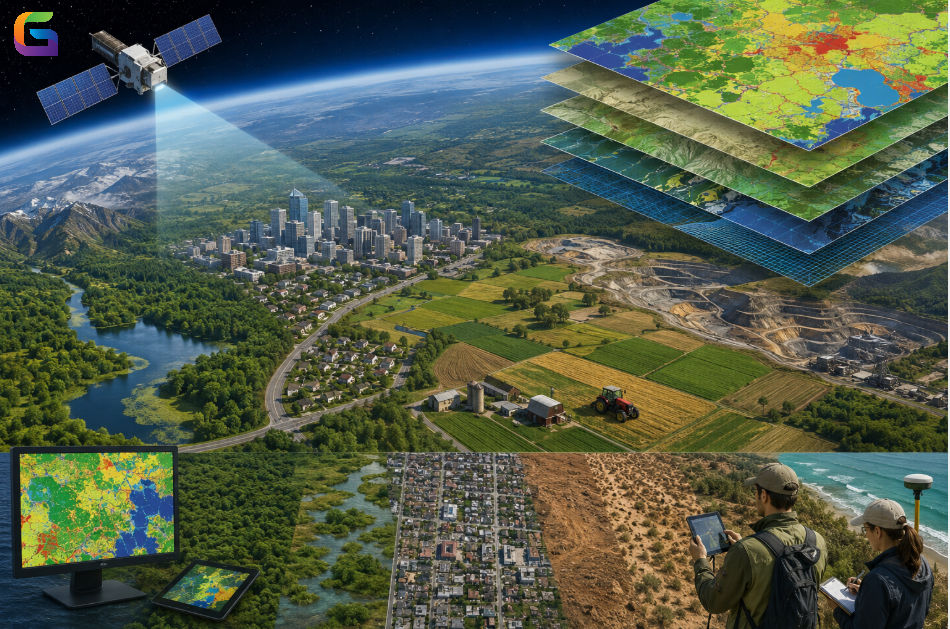
What Is LULC Data?
LULC stands for Land Use / Land Cover. Although they are commonly referred to interchangeably, these two items are distinct:
Land Cover
Land cover refers to the physical material found on the surface of the Earth. Some examples of land cover include:
Forests
Grasslands
Bodies of Water
Wetlands
Bare Soil
Snow/Ice
Urban Surfaces
Simply put, land cover describes what physically exists on the surface of the Earth.
Land Use
Land use refers to how humans use the land in question. Some examples of land uses include:
Residential Developments
Commercial Developments
Agricultural Fields
Industrial Zones
Recreational Areas
Infrastructure (roads, railways, etc.)
Land use describes how humans utilize the land in question.
Put together, Land Use and Land Cover data contain a collection of naturally occurring and anthropogenically influenced features associated with human activity and physical conditions.
Why Is LULC Mapping Important?
Mapping Land Use and Land Cover (LULC) provides organizations and governments with the ability to monitor environmental and socioeconomic changes across barangays.
The following are the benefits:
Environmental Monitoring
LULC data provide tracking information:
Deforestation
Wetland Loss
Desertification
Changes in biodiversity
Fragmentation of habitats.
Urban Planning
Under this heading, the LULC map assists city planners with the following information:
Urban expansion monitoring
Infrastructure project planning
Being able to specify appropriate zones for development
Controlling population growth within city limits.
Agriculture
LULC information can help farmers/agricultural agencies accomplish the following:
Monitor where crops are being grown.
Evaluate land productivity
Enhance their ability to plan for irrigation.
Monitor seasonal land changes.
Climate Change Studies
Researchers can use LULC datasets to measure the following:
Carbon storage
Greenhouse gas emission changes
Changes in the temperature recorded on land surfaces
How land uses will affect climate change adaptation.
Disaster Risk Management
LULC mapping can assist in the following:
Flood risk assessment
Wildfire monitoring
Landslide susceptibility assessment
Emergency management response planning.
How Is LULC Data Created?
LULC Mapping in Modern Times Requires Remote Sensing & Geospatial Technology
Data Collection by Satellite
High-resolution images of the Earth's surface are obtained through the use of EO (Earth Observation) satellites such as;
Landsat
MODIS
PlanetScope
WorldView
These satellites gather images at regular intervals.
Image Preprocessing
The raw photos taken from EO satellites go through several corrections, including;
Atmospheric correction
Radiometric correction
Geometric Correction
Cloud masking
The statistics from this process will be used for analysis.
Feature Extraction,
Analysts will extract certain features from the image data.
Vegetation index (NDVI)
Water index (NDWI)
Surface reflectance value
Textures characteristics
These will be used for identifying LULC (Land Use Land Cover)
Classification
Classification techniques such as machine learning and image classification techniques are used to label every pixel into a pre-determined classification.
The most common types of classification are supervised and Unsupervised.
A supervised classification uses experts to determine training samples.
Examples - Random Forest, Support Vector Machine (SVM), Neural Networks
An unsupervised classification groups all of the pixels together based on spectral similarity.
Examples - K-Means Clustering, ISODATA
Accuracy Assessment / Validation
The final map is validated through;
Ground truth surveys
GPS collected data in the field
High-resolution satellite imagery
The accuracy of the final map is measured by;
Overall accuracy
Producer's accuracy
User's accuracy
Kappa Coefficient
Best Practices for LULC Data Utilisation
The following guidelines maximise the benefit of LULC datasets:
Always begin your analysis by using the most current imagery available.
Choosing the right classification scheme is critical t..o the success of your project's data analysis. Select an appropriate scheme for your specific project's needs.
Validate the results from your dataset by conducting field observations on-site.
Consider seasonal differences during your analysis of LULC data.
Update your datasets regularly to ensure that they reflect changes in land ownership over time.
For added insight into the relationships between LULC data and other factors, use LULC datasets in combination with demographic, climate, and infrastructure datasets.
LULC data are essential to modern geospatial analysis. By providing information about both the physical characteristics of the earth's surface and the human-related activities taking place within and on that surface, LULC mapping is an important resource for environmental conservation, urban development, agriculture, climate research, and infrastructure investment.
Remote sensing technology, artificial intelligence, and cloud computing are rapidly advancing, making LULC data increasingly precise, more accessible, and more valuable for organisations worldwide. By understanding how LULC data are created and used, professionals can make use of data-supported decision-making in order to promote responsible management of the world's resources and ensure long-term protection of the environment.
For more information or any questions regarding LULC Data, please don't hesitate to contact us at
Email: info@geowgs84.com
USA (HQ): (720) 702–4849
India: 98260-76466 - Pradeep Shrivastava
Canada: (519) 590 9999
Mexico: 55 5941 3755
UK & Spain: +44 12358 56710


Comments