
Historical Satellite Imagery: Uses in Modern GIS

Updated: Aug 26
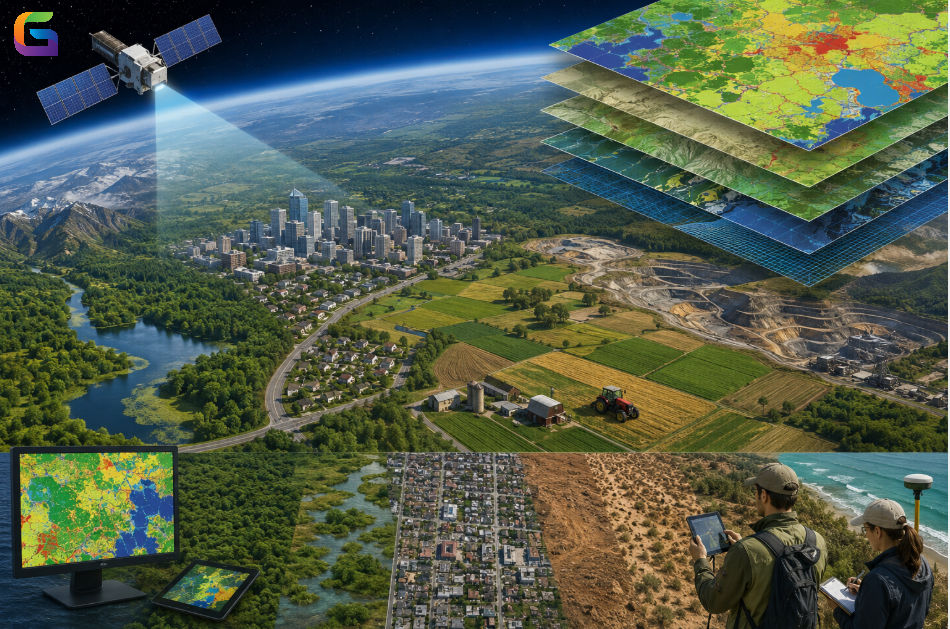
Habitually referred to as old satellite maps, historical imagery from satellites (satellite images) is one of the most significant factors that influence the way GIS operates today. In addition to supplying real-time geographic data, through analysis of the past Earth's conditions, we can make long-term plans, monitor our environment, and manage spatial decisions.
This article provides an overview of historical imagery from satellites, its sources, and how it continues to serve a major function in current GIS industries.

What Are Old Satellite Maps?
Archived satellite imagery is the term used for older satellite maps that have been captured by earth-observing satellites in the past. These images can be geo-referenced and imported into geographic information system software the same way as modern datasets.
While traditional paper maps were typically produced from photos taken on specific dates, your archived satellite imagery provides:
Objective, time-stamped observations of the Earth from space
Consistent spatial coverage across the Earth as a whole
Multi-spectral data can be used for analysis beyond visual interpretation.
Some of these archived datasets are from as far back as the early 1970s and are valuable resources for long-term studies of land use.
Major Sources of Historical Satellite Imagery
Landsat Programme (1972-Present)
The Landsat archive represents the primary source for examining satellite images at this point in time for nearly fifty years. The Landsat imagery is utilized in a variety of applications, including:
Change detection of land-use and land cover (LULC),
Research into urban expansion,
Monitoring of vegetation health.
The most significant benefits of the Landsat Archive are as follows:
Available to all with free/open access,
Worldwide coverage,
Constant spatial resolution (30 m).
CORONA Satellite Coverage (1960-1972)
The original classification of the CORONA Satellite image provides some of the earliest images to show Earth via satellite. Some examples of useful applications for CORONA images within GIS include:
Location of archaeological sites,
Restoration of historical urban centres,
Landscape analysis before development.
Although CORONA images cannot be classified as multispectral images, they still provide an important historical perspective.
Archive for Historical SPOT Images
Since the 1980s, satellites in the SPOT constellation have provided images at either a low, medium, or high resolution.
Some typical uses of this resource include:
Monitoring the growth of urbanisation
Detecting changes in crop cover over time.
Comparing the effects of a disaster on a site before and after the event.
Declassified Aerial and Military Imagery
Scanned and georeferenced aerial photographs in combination with satellite data enable researchers to create historical timelines for historical studies.
How Historical Satellite Imagery Is Used in Modern GIS
Analysis of change detection
Temporal Change Detection (also referred to as Change Detection in GIS) refers to an application of GIS that consists of comparing images for two or more years to identify changes; for example:
Deforestation
Coastal Erosion
Glacier Retreat
Urban Sprawl
Examples of tools in GIS that utilise historical data from satellite images, such as Raster Differencing, NDVI Comparisons, and Classification Workflows.
Urban Growth/Planning
Urban planners can use satellite images created many years ago to:
Monitor city growth
Assess zoning compliance
Predict urban growth
Using historical imagery provides planners with the means to develop evidence-based conclusions that aid in making sustainable planning decisions.
Environmental/Climate Research
Without historical satellite data, it is not possible to perform a systematic environmental assessment over time. The following are examples of how scientists are using historical imagery for:
Assessing the impacts of climate change
Examining wetland loss
Studying desertification
Tracking forest regeneration
For both historical and current satellite images to be analysed consistently over time and across sources, it is crucial to use the same coordinate reference system, such as WGS 84.
Disaster Evaluation and Recovery
GIS Analysts use Historic Images to Set Pre-Disaster Baseline Data for Accurate
Damage Evaluation
Risk Modeling
Recovery Assessment
Historic Images of Disasters (Floods, Earthquakes, Wildfires, Hurricanes) have been very useful in making accurate assessments of damages, models of risk, and Recovery evaluations.
Environmental & Land Use & Boundaries
Increasingly, Historic Satellite Images are used for
Resolution of Land Use Disputes
Verifying Property Boundaries
Determining Invoking Claims of Infrastructure Rights-of-Way
When paired with Cadastral Data, Historic Imagery Provides Temporal Evidence in Support of Spatial Claims.
Technical Challenges of Using Old Satellite Maps
Historical satellite imagery is a powerful source of information, but it does have some challenges:
Georeferencing Accuracy
Older satellite images typically provide the following to georeference geospatially:
Manually georeferenced Ground Control Points (GCP)
Datum transformations
Alignment of data coordinates to a common coordinate system (typically WGS 84).
Resolution and Sensor Differences
Earlier satellites provided:
Earlier satellites had:
Lower spatial resolution
Limited spectral bands
Different radiometric properties
Modern GIS workflows compensate using resampling, normalization, and machine learning techniques.
Data Consistency
Having consistent data over decades necessitates careful data preprocessing, particularly when using multiple satellite image datasets to obtain data from several different satellite missions.
Why Historical Satellite Imagery Still Matters Today
Historical Satellite Data is still relevant today, even with improved methods for real-time monitoring of our planet, namely, through Historical Satellite Imagery.
Knowing Where You Came from, as far as past Geography is concerned.
Evidence of change over Time
Continued Data for Historical Soils Studies
GIS is not just about Where Your Buildings have been built; it's about understanding how they got there!
Historical Satellite Data is more than a set of data for someone to "look at". They are the cornerstone datasets for understanding Urban Development, Environmental Impacts, Risk Management, and Land Register at present, and for Predicting Future Development. Historical Satellite Imagery is what helps to contextualize and understand our current world, making it easier to make informed and strategic decisions about our future through the data generated from that imagery.
For more information or any questions regarding the old satellite maps, please don't hesitate to contact us at
Email: info@geowgs84.com
USA (HQ): (720) 702–4849
India: 98260-76466 - Pradeep Shrivastava
Canada: (519) 590 9999
Mexico: 55 5941 3755
UK & Spain: +44 12358 56710


Comments