
Land Surface Temperature: Importance for Climate and GIS

Updated: Aug 26
Land Surface Temperature (LST) plays an important role in Environmental Studies, Climate Change Research, and investigating the Geographic Regions of the Earth. LST is rapidly becoming an important tool, particularly in the context of increasing Global Average Temperatures, increasingly Urbanized Areas, and Climate Change.
The use of LST will allow GIS Professionals and Geographic Researchers to understand Climate Change, Urban Heat Island Effects, Health, and the Sustainability of Agriculture and Urban Development.
In this blog post, we will discuss the definition of LST, how we measure LST, and how GIS converts this raw data into the actual results.
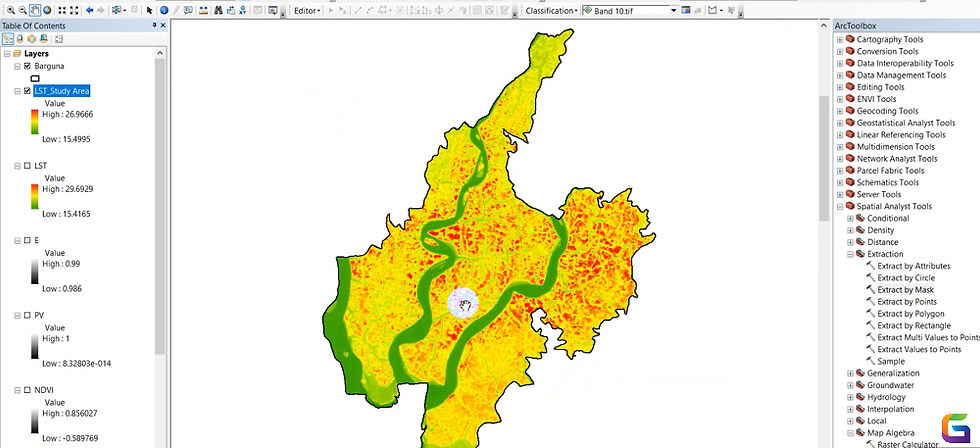
What Is Land Surface Temperature (LST)?
Land Surface Temperature is defined as the radiative temperature of the Land Surface of the Earth as measured through Remote Sensing. Unlike Air Temperature, which measures the temperature of the atmosphere around the Earth at approximately 2 m above the ground level, LST provides an actual representation of the temperature at the ground and vegetation surfaces.
LST is driven by several Variables:
Surface material (soil, vegetation, water, concrete)
Moisture content
Time of day and season
Land cover and land use
Incoming solar radiation
Because it directly represents how the land interacts with energy, LST is crucial for understanding both local and global thermal dynamics.
The Value of LST: The Fundamental Uses
Observing the Effects of Climate Change
There is a direct connection between land surface temperature and global warming trends. Long-term LST data from MODIS and Landsat satellites are used to:
Track shifting climates by tracking regional warming over the years
Understand how droughts and heat waves affect agriculture.
Understand how land cover interacts with climate.
Long-term land surface temperature information from space provides the only continuous global view of temperatures over time.
Determining Urban Heat Islands
Urbanization and urbanization speed up the heat because they are built on solid surfaces such as concrete and asphalt, and have reduced vegetation coverage. LST is the key component in determining:
The relative intensity of urban heat islands
Thermal differences between rural and urban
City planning methods for cooling methods such as tree planting and reflective roofs.
Using GIS tools to map urban heat islands produces thermal maps, which are helpful for sustainable urban design.
Farming and Crop Health
Farmers and agricultural researchers rely on LST data to determine:
The amount of water that plants will need to survive and grow.
Soil moisture levels
The amount of stress on crops from the heat
How much water is lost to evapotranspiration (the process of water evaporating from the ground and being absorbed into the air)
The integration of LST with vegetation indices (NDVI, EVI) also aids in/the management of crop production and irrigation systems.
The Importance of LST in Hydrology and Drought Assessments
LST will support hydrologic modelling by, among other things, providing the following data:
Drought Risk - Areas with Dry Soil
Evapotranspiration Stress
Surface Water Temp Variation
Drought Early Warning Systems improve from the use of LST in conjunction with other Remote Sensing Data.
Disaster Management
Wildfires, volcanic eruptions, and heat waves provide Time Surface Temp Data on:
A crucial role in Environmental Studies, Climate Change Research, and the Investigation of Earth's geographic regions
Fire Intensity Assessment
Burn Area Assessment
Post Disaster Recovery Planning
Emergency Response time is enhanced by the use of Resolution Thermal Imaging and LST.
How Is Land Surface Temperature Measured?
Satellite-based thermal infrared sensors (TIRs) provide most of the data for calculating land surface temperature (LST). Some of the most common methods for measuring LST include:
NASA's MODIS (Moderate Resolution Imaging Spectroradiometer)
Daily global data availability
Moderate resolution (1 kilometer)
Ideal for monitoring the global environment on a large scale.
Landsat 8-9 TIRS (Thermal Infrared Sensor)
High resolution (100 meters)
Revisit every 16 days.
Utilized for urban and agricultural studies and local-level analyses.
ECOSTRESS (Thermal sensor located onboard the International Space Station)
Very high temporal resolution
Focuses on plant-water stress and surface temperature variability
These sensors measure emitted thermal radiation and convert it to temperature using atmospheric correction and emissivity models.
LST and GIS: A Powerful Combination
GIS software, including ArcGIS, QGIS, Google Earth Engine, and Python-based tools such as rasterio and xarray, provides users with a user-friendly way to examine LST data. Each GIS application provides users with a wide variety of options for analysis.
Through GIS, LST provides the following:
Using LST maps with a variety of gradients or colors to assist in visualizing temperature distributions across space.
The ability to analyze time series data (e.g., warming and cooling trends).
The ability to compare and contrast LST data across different land cover types (e.g., wetland vs. urban environments).
The ability to analyze relationships between LST and other datasets (e.g., NDVI, land use, elevation, and population density).
For Example:
In order to enhance heat mitigation areas, urban planners may overlay LST maps with zoning maps.
Ecologists can use LST data along with species habitat data to determine the vulnerability of particular species to climate change.
Hydrologists can use LST data along with precipitation and soil data to predict drought events.
Challenges in LST Analysis
The presence of clouds blocks thermal radiation from reaching the satellite sensor.
Variability of the emissivity of surfaces, which results in the same surface material producing different amounts of thermal energy.
Effects caused by the atmosphere, which require corrections for accurate results.
Long periods of time between satellite passes (revisit times);
In order to improve the accuracy and usability of LST, modern algorithms are continuously improving, as well as platforms that utilize cloud computing for processing.
In addition to being a thermal measurement, LST provides a window into the health and sustainability of the planet, as well as its future. From studying climate change trends to providing input for urban planning and agricultural practices, LST provides valuable information regarding how we can best utilize the available resources to make better-informed decisions.
As the use of GIS and the availability of satellite data continue to increase, the importance of using LST for environmental analysis will only continue to grow. Whether you are a data analyst, climate researcher, urban planner, or GIS analyst, learning how to work with LST will be an invaluable skill.
For more information or any questions regarding the land surface temperature, please don't hesitate to contact us at
Email: info@geowgs84.com
USA (HQ): (720) 702–4849
India: 98260-76466 - Pradeep Shrivastava
Canada: (519) 590 9999
Mexico: 55 5941 3755
UK & Spain: +44 12358 56710


Comments